
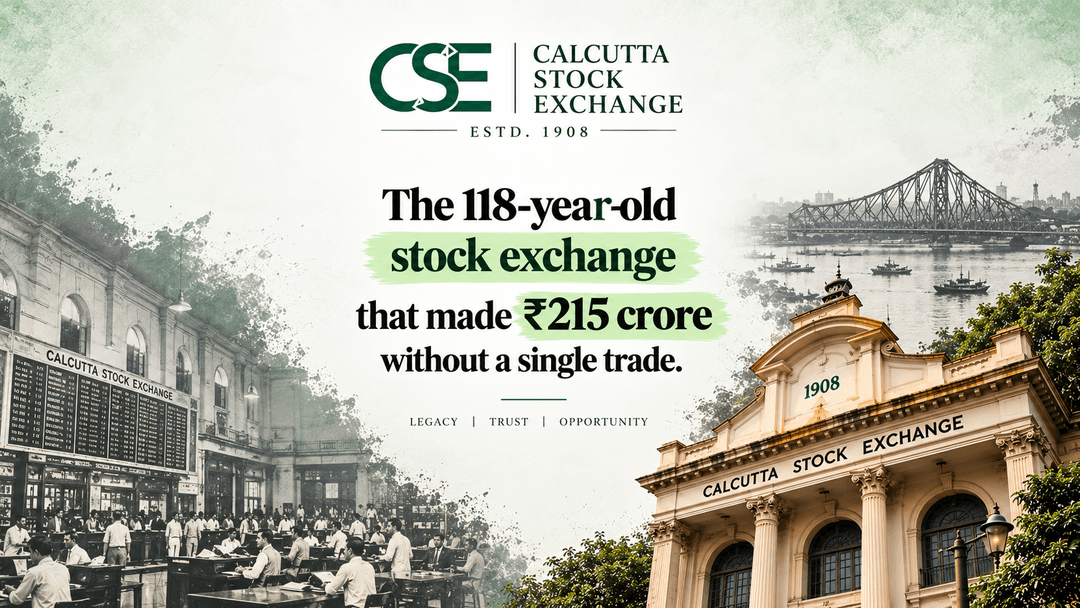
Picture this. It's 7, Lyons Range, Kolkata. A grand building from 1928. Around it, brokers once shouted over each other, and this was where eastern India raised its money. The Calcutta Stock Exchange (CSE) was founded in 1908, and for a long stretch it was one of the most important exchanges in the country, at times rivalling Bombay.
Now fast forward to FY 2025-26. CSE has 1,507 listed companies and about 500 registered brokers. Trading volume: zero.
And yet, it reported a profit after tax of ₹215.6 crore. The year before, it had lost ₹21.9 crore.
So what's going on? Let's back up a bit.
Slowly, as it turns out.
The trouble started when NSE arrived in the 1990s with screen-based, nationwide trading. A broker in Kolkata no longer needed a Kolkata exchange. He could trade on NSE from his desk. Regional exchanges across India began losing volumes, one after another.
CSE also took a heavy hit to its reputation in 2001, when it went through a payments crisis linked to the Ketan Parekh scam. Brokers defaulted, and trust took a beating. (Remember this crisis. It shows up again on the balance sheet.)
Then in 2012, SEBI set the bar for survival: regional exchanges had to meet minimum turnover and net-worth requirements, or leave. Most couldn't, and dozens of regional exchanges shut down.
CSE didn't go quietly. SEBI suspended its trading from April 3, 2013, and in 2015 it started the process of forcing CSE to exit. CSE went to the Calcutta High Court, and in 2017 the court stayed the exit. After that, the report describes the exchange as existing in a "twilight state": still legally a recognised stock exchange, but doing nothing as one.
Which leads to an obvious question. How does a business like that earn money?
A normal stock exchange makes money in three main ways: transaction fees on trades, listing fees from companies, and selling data and technology services.
CSE has no trades, so the first stream is gone. It isn't selling any data either. What's left looks like this:
1. Listing fees from companies that can't trade. The 1,507 companies are still listed, so they still owe annual listing fees. In practice CSE is mostly chasing old unpaid dues from suspended companies. Listing fees came to ₹1.9 crore, down from ₹4.1 crore the year before.
2. Processing charges. These were ₹2.5 crore. The report doesn't spell out what they are, but 87 companies voluntarily delisted during the year, so a good guess is that CSE gets paid for handling the paperwork of companies leaving. There's a bit of irony in that: the exchange earns money from companies on their way out.
3. Interest on its cash. This is the most important stream. Over decades CSE built up a pile of reserves, and it keeps them in fixed deposits, PSU bonds and government securities. Interest and investment income came to about ₹15.7 crore, which is three times what the "exchange business" itself earned.
Add these up and total revenue from operations was just ₹5.1 crore, down 55% in a year. Put simply, CSE today is a treasury company that also looks after a list of companies nobody trades.
So where did ₹215 crore of profit come from?
CSE held the lease on 3 acres of land on Kolkata's E.M. Bypass. It brought in property consultant JLL to run an auction, and Srijan Infrapromoters won with a bid of ₹253 crore. SEBI gave its no-objection in December 2025, shareholders approved the deal in January 2026, and the money arrived.
After costs, the profit on the sub-lease came to ₹249.3 crore. That single transaction was worth about 50 times CSE's entire operating revenue for the year.
Meanwhile CSE had also cut costs sharply. It ran a voluntary retirement scheme (that was most of the FY25 loss: a ₹21 crore provision), and it now saves roughly ₹9 crore a year. Employee costs fell from ₹11.4 crore to ₹2.2 crore. Total expenses for the year were just ₹8.8 crore.
So the FY26 numbers break down as a one-time windfall of about ₹249 crore plus a small, fairly steady business earning around ₹12 crore before tax.
At first glance, CSE's balance sheet looks strong. Total assets are ₹600 crore, there's zero borrowing, and net worth has more than doubled from ₹182 crore to ₹402 crore in one year.
But a stock exchange's balance sheet is a bit like a bank locker room. Many of the lockers hold other people's valuables. So let's go through it and separate what actually belongs to CSE from what CSE is only holding for someone else.
Locker 1: The ghost of the payment crisis
On the assets side there's an item called "Receivable from defaulting members" worth ₹94.2 crore. It's money that 15 brokers owe CSE from settlements that failed years ago. CSE has filed recovery suits, but the matter is still in court, and even the company says it can't tell how much it will ever recover.
Now look at the liabilities side. There's a matching ₹94.2 crore entry under "Sundry Deposits." This is money the Settlement Guarantee Fund and some members put in to cover the crisis back then, and it has to be returned only if the defaulters pay up.
The two entries cancel each other out. It's an old wound, most likely from that 2001 crisis, that is still on the books, and it adds nothing to CSE's real value.
Locker 2: Members' money
Brokers had to keep security deposits with the exchange as base capital: ₹64.1 crore in shares, about ₹12 crore in FDs, and another ₹18 crore in cash. These sit on both sides of the balance sheet, because the assets are held by CSE but they belong to the brokers. That accounts for most of the ₹97 crore of "current liabilities." Again, it's not CSE's money.
Locker 3: Ring-fenced funds
Inside the ₹402 crore net worth are two funds CSE can't spend as it pleases:
Settlement Guarantee Fund (₹61.3 crore): a safety net meant to guarantee trades.
Investors' Service Fund (₹16.3 crore): meant for investor protection and services.
Both are kept in separate, earmarked FDs and government bonds, and the interest they earn goes straight back into them.
What's actually CSE's
With all that set aside, here's how it looks:
₹ crore | |
|---|---|
| Total net worth | 402 |
| Less: Settlement Guarantee Fund | (61) |
| Less: Investors' Service Fund | (16) |
| CSE's own reserves | ~325 |
| Of which locked in FD with SEBI lien | (216) |
| Own money CSE can use | ~109 |
That ₹216 crore is the land money. SEBI allowed the deal on the condition that most of the proceeds be kept in a fixed deposit with a lien in its favour, and another ₹34 crore went to paying capital gains tax. The money belongs to CSE on paper, but CSE can't freely use it.
That's why a company with a ₹215 crore profit is declaring no dividend. Shareholders are getting bonus shares instead, which means more shares but no cash in hand.
Note also where CSE's cash is kept. Most of it sits in fixed deposits, with some in long-dated government securities (maturing in 2051 and 2061), PSU bonds and mutual funds. This is the money that produces the ₹15.7 crore of annual interest. For CSE, the balance sheet effectively is the business.
CSE has only 6,11,250 shares with a face value of ₹1 each. Divide the numbers by that tiny share count:
Book value per share: about ₹6,578 (₹402 crore of net worth ÷ 6.11 lakh shares)
Using only CSE's own reserves (leaving out the two ring-fenced funds): about ₹5,300 per share
Earnings per share (FY26): ₹3,527 (it was –₹358 the year before)
In a single year, EPS came to more than half of the book value. That doesn't happen in a normal business, and that's the land windfall showing up. Take it out, and the regular business earns only a small fraction of that.
One thing to keep in mind: once the bonus shares are issued, the share count goes up and all these per-share figures come down in proportion. The annual report states the bonus ratio two different ways ("1:2" and "two shares for one"), so check the official corporate announcement before doing the maths.
Accounting rules make companies record assets at their original cost, not what they're worth today. CSE's property, plant and equipment is shown at just ₹27.7 crore, and its freehold land appears at a cost of about ₹4.15 lakh.
For an exchange that has held prime Kolkata property for decades, the real market value is very likely much higher than these figures. The E.M. Bypass deal already proved it: land carried on the books at about ₹3.8 crore brought in ₹253 crore.
That's also why SEBI brought in a valuation agency for the exit process. What CSE is really worth, and who gets that value, hasn't been decided yet.
This is where the story becomes a genuine cliffhanger.
The exit path. In February 2025, CSE applied to SEBI to voluntarily exit the stock exchange business, and shareholders approved it in an EGM. SEBI appointed a valuation agency to assess its assets and liabilities. Under this path, CSE closes as an exchange and its value is roughly what its assets are worth.
The revival path. Then West Bengal's 2026-27 budget said the state would support reviving the 118-year-old exchange to "reclaim Kolkata's place as a financial capital." In June 2026, CSE's board asked SEBI to put its own exit application on hold.
The revival pitch in the annual report is ambitious: green bonds, blue bonds, carbon credits, SME and MSME listings, urban infrastructure financing, and even a mutual fund business. For clearing and settlement, it would build its own clearing corporation or tie up with ICCL or NSE Clearing.
The problem is that every one of these needs things CSE doesn't currently have:
SEBI's approval, from a regulator that has been trying to shut CSE down since 2015.
Anchor investors with enough capital and "fit and proper" credentials.
Technology that can match NSE and BSE.
Liquidity, meaning traders and issuers who choose CSE over two exchanges that already dominate Indian trading.
Of these, liquidity is the hardest. Exchanges have strong network effects: traders go where the other traders are. Specialised niches like green bonds or carbon credits might give CSE a way in, but that's a big "might."
For now, CSE is best understood as a cash-rich shell with a stock exchange licence and a lot of history. Its routine business earns a modest income from interest and listing fees. After you remove the old crisis entry, the brokers' deposits and the ring-fenced funds, CSE owns about ₹325 crore, and two-thirds of that is locked with SEBI. There may also be extra value in property that the books don't show. Its biggest asset turned out to be land, not market infrastructure, and its future depends on regulators and politics rather than on its own operations.
Will the Calcutta Stock Exchange ring its opening bell again, or become a heritage building with a big bank balance? We'll be watching.
Until then…
Don't forget to share this with the friend who still thinks there are only two stock exchanges in India.