
Picture this. You run a gas-fired power plant. It's October, electricity demand is up, and you suddenly need extra gas for the next two weeks.
A few years ago, your options were limited. You'd call a big supplier, haggle over a contract, and hope the price was fair. Nobody outside that room knew what anyone else was paying.
Today, you can just log in to the Indian Gas Exchange (IGX), see a live price, and buy what you need. Delivery included.
And last month, a lot of people did exactly that.
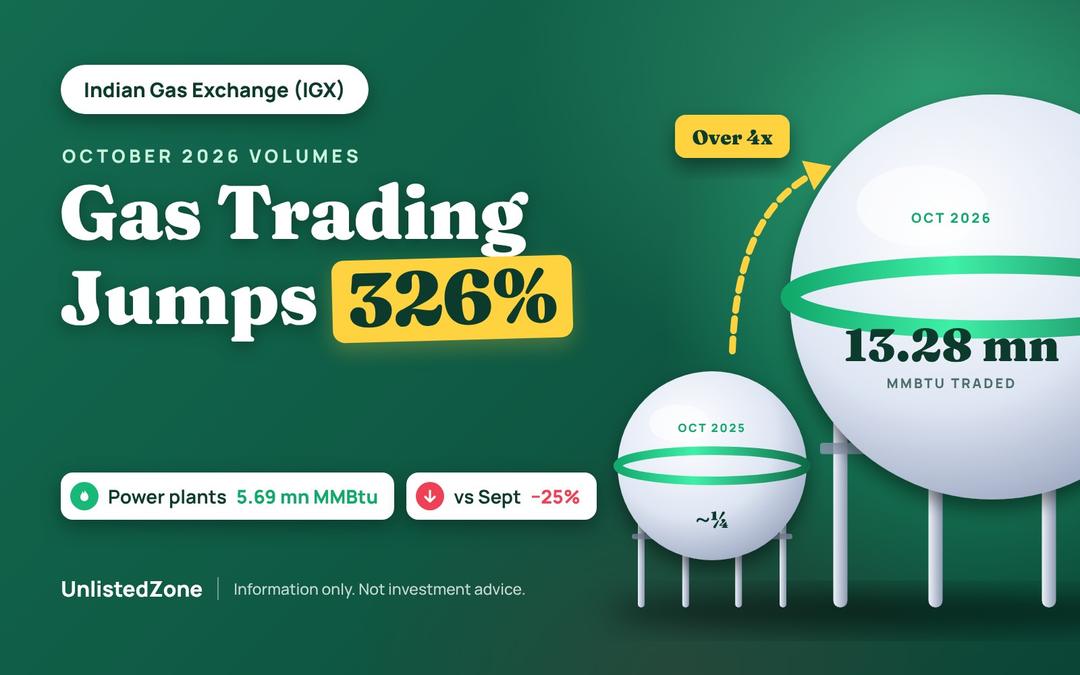
In October 2026, IGX traded 13.28 million MMBtu of gas. That's 326% more than in October 2025. Put simply, this October was worth more than four of last year's Octobers.
Wait, what's an MMBtu? It stands for million British thermal units. It measures how much heat energy the gas holds, and it's the standard unit gas is priced in around the world. Think of it as the "kilogram" of the gas market.
Here's the month in one table:
What | October 2026 | Change |
|---|---|---|
| Gas traded | 13.28 million MMBtu | +326% YoY, −25% MoM |
| Free-market gas | 10.08 million MMBtu (75.88%) | — |
| Bought by power plants | 5.69 million MMBtu | — |
| GIXI benchmark price | ₹2,471 (USD 25.87) per MMBtu | +154% YoY, −9% MoM |
| Gas delivered | 15.05 million MMBtu (12.23 MMSCMD) | — |
| Best single day (intraday) | 0.30 million MMBtu | All-time high |
Not so fast.
Compared with September, October volumes actually fell 25%. So this wasn't a record month. It was a strong month against a weak base.
That's the nature of a young market. Gas buying in India still comes in bursts. A heatwave, a dip in LNG prices or a power plant scrambling for fuel can swing volumes sharply from one month to the next.
The better way to read IGX is the long view. A year ago, it was handling about a quarter of what it handles today. The trend is going one way, even if the ride is bumpy.
Two very different crowds.
Crowd one: the city gas companies. These are the folks who pipe gas into your kitchen (PNG) and fill up CNG autos and cabs. In October, they bought every unit of domestic HPHT gas sold on IGX. That's gas from India's deep, high-pressure, high-temperature fields, and it made up 24.12% of the month's volume.
Crowd two: everyone in the free market. This is the bigger slice, 75.88% of volume or 10.08 million MMBtu. And the biggest shopper here? Power plants, which took 5.69 million MMBtu. That's more than half of all free-market gas.
What's interesting is how the power plants bought. They weren't just grabbing gas day to day. Most of them locked in supply for the rest of the month:
How power plants bought | Share |
|---|---|
| Balance-of-month contracts | 57.22% |
| Intraday and day-ahead | 27.48% |
| Fortnightly contracts | 15.30% |
That's a sign of trust. You don't plan your whole month on a platform you're unsure about.
Producers are showing up too. About 15.43 million standard cubic metres of domestic gas with pricing freedom was sold from the Jaya, Hazira-ONGC, Suvali and Bokaro CBM blocks. And if you're wondering where most of the free-market action happened, it was Dahej in Gujarat.
It did. IGX's benchmark price, the GIXI, stood at ₹2,471 (USD 25.87) per MMBtu in October. That's 154% higher than a year ago, though about 9% cheaper than September.
Now, you'd think pricier gas would scare buyers off. But here's the thing about exchanges: they don't really care whether gas is cheap or expensive.
Think of IGX as a toll booth on a highway. The toll booth doesn't own the trucks or the cargo. It just earns a small fee every time a truck passes. More trucks, more money.
In fact, volatile prices can push more traffic onto the exchange. When prices swing wildly, buyers and sellers want a transparent, public price to lean on. That's exactly what the GIXI gives them.
A marketplace is only as good as its delivery. Buying gas on a screen is pointless if it can't reach you.
So IGX has been quietly laying down the plumbing. It now has 19 delivery points, from LNG terminals to pipeline junctions to spots where domestic gas fields come ashore. In October, 15.05 million MMBtu of gas was physically delivered, about 12.23 million standard cubic metres a day. It also hit its biggest single day of intraday trading ever, at 0.30 million MMBtu.
Then there are the products. IGX offers 12 standard contracts, including longer ones of three months, six months, one year and two years.
Why does that matter? Because a buyer on a one-year contract shows up every single month. Not just when spot prices look tempting. That's the difference between a flea market and a supermarket with loyal customers.
Because IGX is about to go public.
In October, IGX got SEBI's nod for its IPO. And there's a deadline driving it. Its parent, Indian Energy Exchange (IEX), owns 47.28% of IGX. The rules for gas exchanges cap that at 25%, and the regulator has given IEX until December 31, 2026 to get there.
So the IPO is a pure offer for sale. IEX will sell up to 1.67 crore shares, and IGX itself won't receive a rupee. The other big names on the cap table include NSE Investments with 24.75%, while ONGC, GAIL, Torrent Gas, Adani Total Gas and Indian Oil hold 4.92% each. If all goes to plan, IGX will list on BSE and become India's first listed gas exchange.
Meanwhile, IGX shares already trade in the unlisted market at an indicative ₹475 each on UnlistedZone, as of 7 November 2026.
Which brings us back to October. When new investors size up an exchange, they ask one question first: is more stuff moving through it? This month, the answer was a loud yes on the yearly view, with a reminder that month-to-month can be choppy.
For years, buying gas in India was a phone call and a handshake. IGX is slowly turning it into a screen and a price everyone can see.
October showed the idea is catching on. Power plants are planning their month around it. City gas companies rely on it. Producers are selling through it.
The toll booth is getting busier. And very soon, you may be able to own a piece of it on the stock market.
Until then…
How much gas did IGX trade in October 2026? 13.28 million MMBtu, up 326.03% from October 2025 and down 25.25% from September 2026.
What was the GIXI price in October 2026? ₹2,471 (USD 25.87) per MMBtu, up 154.44% year on year and down 8.89% month on month.
What is the IGX unlisted share price? The indicative price on UnlistedZone is ₹475 per share as of 7 November 2026.
Will IGX raise money in its IPO? No. The IPO is a pure offer for sale of up to 1.67 crore shares by IEX, so the proceeds go to IEX.
This article is for informational purposes only and should not be construed as investment advice. Unlisted share prices are indicative. Please do your own research or consult a financial advisor before investing.