GFCL EV Products Limited, a wholly-owned subsidiary of Gujarat Fluorochemicals Limited (GFL), is a strategic supplier of battery materials, positioned to capitalise on the global shift toward electric mobility and energy storage. It operates a fully integrated battery materials complex, positioning itself as a battery-agnostic materials player catering to both LFP and NMC chemistries.
Its integrated business model spans over 50% of the lithium-ion battery value chain. Product portfolio:
Electrolyte salt (LiPF6)
Additives (FEC, VC)
Electrolyte formulations (salt + additives + solvents)
Cathode Active Material — LFP (CAM)
Binders (PTFE, PVDF)
Anode Active Material — Natural Graphite (NGAAM)
This basket covers ~70% of the value of an LFP cell, making GFCL EV possibly the only company ex-China offering multiple battery chemicals under one roof — versus 1–2 product suppliers typically found across South Korea, Japan and the EU.
Problem Being Solved: GFCL EV reduces global (particularly Western) EV/battery makers' dependence on China-dominated battery chemical supply chains by offering a one-stop, ex-China source for multiple battery chemicals — addressing supply-chain security and geographic diversification needs, reinforced by US policy (OBBB, see Section 5).
Revenue Model:
RoCE-based pricing: pricing is set on an underlying Return on Capital Employed (tied to overall investment), which limits earnings volatility and passes raw-material inflation through to customers
Revenue backed by client contracts/approvals rather than speculative capacity — reduces ramp-up risk
LiPF6 uses a generic spec supplied across customers; LFP CAM and binders are customer-tailored products
CAM: Lithium Carbonate, Phosphoric Acid, Iron Sulphate → Carbon Precursor + Phosphates of Lithium/Iron → CAM
Electrolyte/LiPF6: LiF, Phosphorous Pentachloride, HF → LiPF6
Electrolyte formulations: Electrolyte salt + Additives + Solvents
Binders (PVDF/PTFE): HF, Chloromethanes → monomer intermediates → polymerised into Fluoropolymers
Anode (NGAAM): Natural Flake Graphite → grinding, shaping, chemical purification, HF-based purification, coating
Backward integration: sources lithium carbonate from China but is backward integrated into AHF (currently from parent GFL; dedicated capacity being added in GFCL EV), solvents and additives — de-risking its supply chain.
Product-wise Status:
Product | Qualification Status | Commercial Sales Timeline |
|---|---|---|
LiPF6 (Electrolyte Salt) | Approved/audited by major global players (Japan, Korea); supply into US | Scale-up on track, orders in place FY27E+ |
LFP CAM | Initial customer approvals on samples | 2HFY27E |
PVDF/PTFE Binders | Qualification complete | 1HFY27E |
NGAAM (Anode) | Facility being set up (next key capacity addition) | Not yet specified |
LiPF6 constitutes 10–15% by weight of electrolyte formulation but 50–60% of electrolyte cost; purity requirements exceed pharma-grade in certain respects (impurities <1ppm)
Key entry barrier: new entrants need 2–3 years to qualify; any change in Man/Material/Machine/Method triggers full requalification
Component | % of Cell Cost | Covered by GFCL EV? |
|---|---|---|
Cathode | 42% | Yes — LFP CAM |
Anode | 20% | Yes — NGAAM (under development) |
Separator | 12% | No |
Electrolyte | 10% | Yes — LiPF6, additives, formulations |
Others (Al foil, Cu foil, etc.) | 16% | No |
~70% of LFP cell cost (Cathode + Anode + Electrolyte, adjusted) is addressable by GFCL EV's current/planned product basket.
Greenfield integrated battery materials complex located at Jolva, Gujarat. Management indicates the business has crossed the hurdle of plant stabilisation, product validation and customer audits for most products. All Phase I capacity is commissioned and contracted with anchor clients.
Particulars | ₹ Cr |
|---|---|
Capex spent to date | 2,100 |
— of which Capital WIP (CWIP) | 1,000 |
FY27E capex (targeted) | 2,300 |
Aggregate fund-raise to date | 2,300 |
Total planned capex by FY28–29E | 6,000 |
Target: 2x asset turnover and 25%+ EBITDA margin, with full potential realised only post FY29/30E
FY27E capex largely earmarked for growth capex, including NGAAM
Existing land bank to be fully utilised with the ₹6,000 Cr capex programme
Current capacity across products is fully/completely contracted
FY26 Funding Raised / Tied Up (₹ Cr):
Source | Amount (₹ Cr) |
|---|---|
Indian investors | 3,730 or 1,000* |
IFC (International Finance Corporation) | 430 (~US$50mn) |
Middle Eastern sovereign funds (OIA and others) | 1,200 |
Infused/committed by parent (GFL) | 1,100 |
Source (360 ONE) prints "Rs 37.3–10.0 bn" for Indian investors — an internally inconsistent range in the original document; shown here at the lower bound (Rs 37.3bn = ₹3,730 Cr would be the upper reading). Treat this line with caution and refer to primary filings.
Additional events: ₹92.47 Cr raised via private placement (Nov'25); ₹430 Cr CCPS issue approved via EGM (Jan'26)
Setting up HF capacity is difficult in the US, Europe, Korea and Japan — reinforces GFCL EV's backward-integrated HF cost advantage
Global electrolyte salt manufacturers: Korea (4), Japan (2), Europe (2) — GFCL EV is the notable ex-China entrant with a full basket
US "One Big Beautiful Bill" (OBBB) mandates batteries contain ~60% non-Chinese-origin components, rising to 85% over the next few years — a structural tailwind for non-Chinese suppliers such as GFCL EV
Ex-China Li-ion battery cell demand is projected to grow from ~500 GWh (CY26) to ~1.8 TWh (CY30E) — an addressable-market tailwind directly relevant to GFCL EV's product basket.
Demand Drivers:
Global shift towards LFP chemistry on cost advantage across mass-market EV and ESS segments
Pick-up in Battery Energy Storage System (BESS) demand, driven by AI-led power/storage-server growth and BESS-plus-renewables grid stabilisation
Global push to de-risk battery supply chains away from China
Client Geography:
Product approvals span multiple customers and geographies
Biggest end-markets: US (largest), followed by India; local demand in Japan and Taiwan comparatively smaller
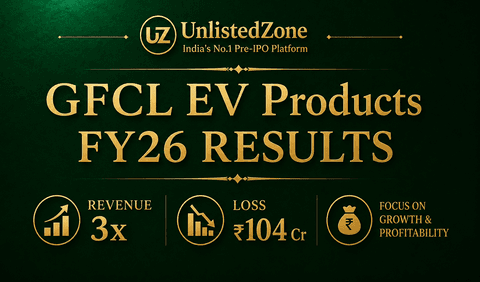
GFCL EV is currently in a heavy investment/ramp-up phase; losses have been widening as capex and operating costs scale ahead of revenue commercialisation.
Particulars | FY23 | FY24 | FY25 | FY26 |
|---|---|---|---|---|
Revenue | 0.0 | 0.4 | 9.4 | 33.2 |
EBITDA | (3.2) | (1.8) | (27.8) | (80.5) |
OPM (%) | — | (481.1%) | (294.5%) | (242.3%) |
PBT | (2.7) | (3.6) | (32.0) | (122.6) |
PAT | (2.7) | (3.0) | (27.0) | (104.3) |
EPS (₹) | (0.01) | 0.00 | (0.04) | (0.14) |
Source: UnlistedZone (company filings). Figures reflect a subsidiary still in scale-up phase — not yet EBITDA/PAT positive.
Management Guidance (per 360 ONE visit):
Battery chemicals segment to reach sizeable triple-digit revenues (₹ Cr) by 4QFY27E
LiPF6 commercial scale-up to continue into FY27E and beyond
LFP CAM commercial sales from 2HFY27E; PVDF binder commercial business from 1HFY27E
Management Guidance (per Axis Capital visit):
FY27E revenue guidance: ₹500–700 Cr, with peak revenue/margin targeted by FY30E
Peak revenue target: ~₹12,000 Cr; EBITDA margin ~25% by FY30E
Phase I LiPF6 salt expansion fully commissioned by Dec'26; binders and LFP CAM ramping with customer approvals expected by Dec'26
Shareholder | Holding (%) |
|---|---|
Gujarat Fluorochemicals Limited (Promoter/Parent) | 96.89% |
Others (incl. IFC, Middle Eastern sovereign funds, Indian investors) | 3.11% |
Execution/ramp-up risk in the battery chemicals business — the central swing factor per both broker visit notes
Delays in product approvals/customer qualifications (LFP CAM, binders, NGAAM) could push back revenue ramp-up and commercialisation
Anode supply chain is nascent for GFCL EV — ~90% of natural graphite anode material manufacturing is currently based in China
Heavy capex programme (₹6,000 Cr by FY28–29E) funded via a mix of equity, debt and internal accruals — funding/execution risk; inability to raise further funds would pressure the balance sheet
Currently loss-making with widening EBITDA/PAT losses (FY26: EBITDA ₹(80.5) Cr) as capex outpaces revenue ramp
Policy risk: US OBBB non-Chinese content mandate is a tailwind today but subject to change
Inability to sell R32 capacity given constrained consumption vs production quota (parent-level risk with read-through)
Guarantees extended by parent group on other Inox group entities (Inox Wind, Inox Wind Infrastructure, etc.) — indirect balance-sheet risk
Sources: 360 ONE Capital Research ("Visit Update", 16 July 2026); Axis Capital Research ("Gujarat Fluorochem – Update", 17 July 2026); UnlistedZone.com company page (accessed 19–20 July 2026). Figures originally reported in Rs mn/Rs bn have been converted to Rs Cr (1 Cr = 10 mn; 1 bn = 100 Cr). This is a compiled summary for internal reference only, not a substitute for the original research reports or independent financial advice.
| Particulars | FY23 | FY24 | FY25 | FY26Latest |
|---|---|---|---|---|
| Revenue | 0 | 37 | 944 | 3,322▲252% |
| EBITDA | -315 | -178 | -2,780 | -8,049▼190% |
| OPM (%) | — | -481.08 | -294.49 | -242.29▲18% |
| PBT | -274 | -362 | -3,203 | -12,256▼283% |
| PAT | -274 | -300 | -2,700 | -10,431▼286% |
| EPS (₹) | -0.01 | 0 | -0.04 | -0.14▼250% |
| Date | Amount Raised | Price | Allotment Type | Instrument | PAS‑3 | Valuation Report |
|---|---|---|---|---|---|---|
| 29 Jun 2026 | ₹290 Cr | ₹1₹1 nominal + ₹0 premium | Preferential Allotment (Private Placement) | Equity Shares | ||
| 08 May 2026 | ₹200 Cr | ₹35₹1 nominal + ₹34 premium | Preferential Allotment (Private Placement) | Equity Shares | — | |
| 18 Feb 2026 | ₹430 Cr | ₹100₹100 nominal + ₹0 premium | Preferential Allotment (Private Placement) | CCPS | — | |
| 26 Nov 2025 | ₹92.47 Cr | ₹35₹1 nominal + ₹34 premium | Preferential Allotment (Private Placement) | Equity Shares | — | |
| 14 Nov 2024 | ₹138 Cr | ₹35₹1 nominal + ₹34 premium | Preferential Allotment (Private Placement) | Equity Shares | — |
Official annual reports and financial statements filed by GFCL EV Products Limited, year by year. PDFs open in a new tab.
Please find below the procedure for buying GFCL EV Products Limited at UnlistedZone.
Please find below the procedure for selling GFCL EV Products Limited at UnlistedZone.
The lock-in period for GFCL EV Products Limited varies depending on the category of investors:
This regulation was introduced by SEBI in August 2021. The rule change, which reduced the lock-in period from one year to six months, was aimed at encouraging more investments in startups that are preparing for public offerings or IPOs. This reduction in the lock-in period is seen as a significant step forward, and since its introduction, many Portfolio Management Services (PMS) have been advising their clients to invest in Pre-IPO shares to capitalize on the benefits of early-stage investments.
However, for SME IPOs, the lock-in period is of One year.
DIS, or Delivery Instruction Slip, is a tool used by investors to sell or transfer GFCL EV Products Limited from their demat account to another. There are two types of DIS Methods:
1. Offline-DIS: This is a traditional, paper-based method for transferring shares. When using Offline-DIS, investors are required to fill out a DIS form and submit it to their broker. The necessary fields in the form include:
a. ISIN number of GFCL EV Products Limited.
b. Name of GFCL EV Products Limited.
c. Quantity of GFCL EV Products Limited.
d. Consideration Amount.
e. Target DP ID and Client ID.
f. Annexure.
2. Online DIS: Some brokers offer the facility to transfer GFCL EV Products Limited through an online DIS system. It's advisable to check with your broker if such a facility is available.
For instance, platforms like Angel Broking provide an Online-DIS feature. In this method, an investor simply needs to add a beneficiary and transfer GFCL EV Products Limited by filling in details similar to those required in the Offline-DIS.
For a more comprehensive understanding of this process, you can refer to our detailed article: https://unlistedzone.com/how-do-i-sell-my-unlisted-shares/
In recent years, the unlisted share market has expanded significantly, leading to a reduction in the minimum investment amount. Previously, the typical investment ticket size ranged from 5-10 Lakhs, but in the current market scenario, it has decreased to between 35-50k. Therefore, through our UnlistedZone platform, if someone wishes to invest in GFCL EV Products Limited, the minimum investment required would now be in the range of 35-50k
Yes, buying and selling unlisted shares in India is indeed 100% legal. This activity is regulated and governed under the guidelines provided by the Securities and Exchange Board of India (SEBI). Investors and traders must adhere to these regulations and guidelines to ensure compliance with legal and financial standards. It's important for participants in the unlisted share market to be aware of and understand these regulations to engage in transactions legally and securely
When you sell unlisted shares within a period of two years from the date of acquisition, any profit earned from the sale is classified as Short-term Capital Gain (STCG). This gain is then added to your total income for that financial year. The tax on this short-term capital gain is calculated based on your applicable individual income tax slab rates. Therefore, the rate at which you will pay tax on the STCG from unlisted shares depends on your total income, including this gain, and the tax slab it falls under as per the prevailing income tax laws in India. It's important for investors to consider these tax implications when engaging in transactions involving unlisted shares.
Long-term Capital Gains (LTCG) on unlisted shares in India refer to the profits earned from the sale of unlisted shares that have been held for more than two years. The key aspects of LTCG on unlisted shares include:
When shares initially bought in the unlisted market become listed, the taxation rules change significantly if these shares are sold through a stock exchange. Here's what investors need to know:
Transition to Listed Market Tax Rates:
Once unlisted shares are listed on the stock exchange and subsequently sold, the tax rates applicable to listed securities come into effect. This shift means that the favorable tax treatments for listed shares, as per the prevailing tax laws, will apply.
Taxation Based on Holding Period:
The crucial factor in determining the type of capital gains tax (Long-term or Short-term) is the holding period of the shares. Importantly, this period is calculated from the original purchase date when the shares were unlisted.
Long-term vs. Short-term Capital Gains: If the shares are sold after being held for more than one year from the date of purchase (including the period when they were unlisted), they are subject to Long-term Capital Gains (LTCG) tax.
Conversely, if sold within one year, Short-term Capital Gains (STCG) tax rates apply.
Significance for Investors: This information is vital for investors in the unlisted market, as it impacts their tax planning and decision-making process. Understanding these nuances ensures that investors can strategically plan the sale of their shares post-listing to optimize tax implications.
Advice for Investors: It's advisable for investors to keep a record of their purchase dates and monitor the listing dates closely. Additionally, staying updated with the latest tax regulations or consulting with a financial advisor is recommended for accurate tax calculations and compliance.
When you purchase GFCL EV Products Limited through UnlistedZone, it's important to note that, as per SEBI regulations, these shares can only be transferred to a demat account.
There are two primary ways to check the credit of GFCL EV Products Limited in your account:
1. Using NSDL or CDSL Applications:
Download the NSDL or CDSL application from the Google Play Store.
To determine whether your stock broker is registered with NSDL or CDSL, you can examine the format of your Demat Account number. The Demat Account number consists of 16 characters, combining the DP ID and Client ID.
DP ID is the unique identification number of the Broker, assigned by CDSL or NSDL.
Client ID is the unique identification number of the Client, representing their portfolio.
In CDSL, the Demat Account number is entirely numeric (e.g., 12345678 for DP ID and 91234567 for Client ID).
In NSDL, the first two characters are alphabetic, representing the country (e.g., 'IN' for India), followed by a 6-digit unique number for the Broker (DP ID) and an 8-digit Client ID (e.g., IN123456 for DP ID and 78912345 for Client ID).
2. Checking in Broker's Application:
The credit of GFCL EV Products Limited can also be checked in your broker's application. However, it's important to note that it may take T+2 days for the shares to show up in the application after the transaction.
The GFCL EV Products Limited are credited in the demat account on the same day as the transfer of funds into our company's bank account.
"The price of GFCL EV Products Limited can be checked in two ways. First, you can join our Telegram channel, where we share the latest prices of all unlisted shares daily in the morning. Secondly, you can check price on our UnlistedZone platform to view historical graphs and prices of all shares in one place."
Investing in GFCL EV Products Limited, like any investment, carries certain risks that should be carefully considered:
1. Liquidity Risk: Unlisted shares, by their nature, are not traded on public stock exchanges. This can result in lower liquidity compared to listed shares, meaning it might be more challenging to find buyers when you wish to sell your shares.
2. Price Volatility: The price of GFCL EV Products Limited can be more volatile compared to listed shares. This is partly due to the lack of regular public trading and potentially limited information available about the company's financial health and performance.
3. Regulatory Risk: Unlisted shares are subject to different regulatory frameworks than listed shares. Any changes in regulations or compliance requirements can impact the value and tradeability of these shares.
4. Limited Information: There may be less publicly available information about unlisted companies. This can make it more difficult to assess the company's true value and potential for growth, increasing the risk of investment.
5. No Guarantee of Future Listing: Investing in GFCL EV Products Limited with the expectation of future listing on a public exchange carries the risk that the listing may not occur. This can affect both the liquidity and potential value appreciation of the shares.
6. Company-Specific Risks: Each company has its own set of risks based on its industry, management, financial health, and market position. These risks can significantly impact the performance of your investment in GFCL EV Products Limited.
UnlistedZone: Pioneering Excellence in India's Unlisted Share Market
UnlistedZone stands as India's fastest-growing and leading marketplace for buying and selling unlisted shares. Over the past 5 years, we have carved a niche in the financial market, website hit user inflows over a 2 million users on our platform since inception. This remarkable journey is underscored by the sheer volume of transactions facilitated through UnlistedZone, which has already surpassed the 300 Crore mark.
At the helm of our success are our esteemed co-founders, Mr. Umesh Paliwal and Dinesh Gupta. Their insights and expertise are regularly sought after by leading financial publications such as MoneyControl, Business Standard, and The Economic Times, particularly for their authoritative views on IPOs and the unlisted market. Our journey over these 5 years has not just been about numbers; it's been about building trust and reliability.
UnlistedZone has established a formidable reputation in the industry, earning the trust and confidence of our users. This trust is our cornerstone, ensuring that new investors can engage with us without the apprehensions of fraud that are often associated with unknown brokers in the market.
At UnlistedZone, we are committed to maintaining the highest standards of transparency and integrity, ensuring that your investment journey is not just profitable but also secure and trustworthy.
Valuation Methodology at UnlistedZone for GFCL EV Products Limited
At UnlistedZone, we employ a meticulous and strategic approach to valuing GFCL EV Products Limited, utilizing two primary methods: Benchmark Valuation Based on Latest Funding:
1. Our first step is to examine the most recent funding round for GFCL EV Products Limited. This provides us with a benchmark valuation, offering a clear indication of the company's current market value as perceived by investors and industry experts. This method is particularly effective in capturing the latest market sentiment and financial health of the company.
2. Comparison with Listed Peers: In cases where there hasn't been recent funding for GFCL EV Products Limited, we adopt a comparative approach. This involves identifying a business in the listed market that closely resembles GFCL EV Products Limited in terms of industry, size, and business model. By comparing and contrasting the two, we can ascertain a fair valuation for GFCL EV Products Limited, drawing on the market data and performance metrics of its listed counterpart.
Investor Advisory: As experts in the unlisted space, we at UnlistedZone emphasize the importance of thorough risk assessment to all our investors. It's crucial to evaluate all risk parameters carefully before investing in unlisted shares. This due diligence is key to making informed and strategic investment decisions in the dynamic and evolving unlisted market.
"At UnlistedZone, our approach to sourcing GFCL EV Products Limited involves a strategic and direct method. Primarily, we acquire these shares from two key groups:
1. Employees of the Company: Often, employees of a company receive shares as part of their compensation or through employee stock option plans (ESOPs). Over time, some of these employees may decide to liquidate their holdings for various reasons, such as financial needs or portfolio diversification. We engage with these employees, providing them a platform to sell their shares.
2. Initial Investors: These are the early-stage investors or angel investors who provided capital to the company during its initial phases. As the company grows and evolves, these initial investors might look to sell part or all of their stake in the company. This could be for reasons like capitalizing on their investment, reallocating assets, or other strategic financial decisions.
By connecting with these groups, UnlistedZone ensures a reliable and consistent supply of GFCL EV Products Limited for our clients. This method not only helps employees and initial investors in liquidating their assets but also provides our clients with access to shares that are not readily available in the public market. It's a win-win for both the sellers and buyers, facilitated efficiently through our platform."
"The Securities and Exchange Board of India (SEBI) does have a regulatory influence on the unlisted market, though it's not as comprehensive as its oversight of the listed markets.
Key aspects of SEBI's involvement in the unlisted space include:
1. Applicable Rules and Regulations: Certain SEBI regulations are indeed applicable to transactions in the unlisted market. This includes the mandatory lock-in period of 6 months, the requirement to pay stamp duty, and depository participant (DP) charges for every transaction. These measures are in place to ensure a certain level of standardization and protection in the unlisted market, similar to those in the listed markets.
2. Lack of Specific Regulation for Unlisted Brokers: As of now, SEBI does not have specific regulations for becoming an unlisted broker. This means that while certain SEBI rules apply to transactions within the unlisted market, the process of becoming a broker in this space is not directly regulated by SEBI. This lack of direct regulation highlights the importance of due diligence by investors when engaging with brokers in the unlisted market.
3. Investor Protection and Transparency: The regulations that do apply, such as the lock-in period and transaction charges, are designed to protect investors and add a layer of transparency to these transactions. They aim to mitigate some of the risks inherent in trading unlisted securities, which typically don't have the same level of public scrutiny and regulatory oversight as listed securities. In summary, while SEBI's regulatory framework does extend to certain aspects of the unlisted market, it does not comprehensively regulate all aspects of it, particularly concerning the accreditation of unlisted brokers. This underscores the need for investors to exercise caution and conduct thorough research when participating in the unlisted market."
"For comprehensive and up-to-date news and information about GFCL EV Products Limited, we have several platforms to keep you informed. Our website is regularly updated with the latest insights and developments. For real-time updates and engaging discussions, you can join our Telegram channel. Additionally, follow us on Twitter for quick news bites and industry trends. And for more in-depth analysis and informative content, subscribe to our YouTube channel. These resources are designed to provide you with a well-rounded understanding of the unlisted market, ensuring you have access to all the information you need about GFCL EV Products Limited."
Indicative prices, company research and your enquiries — in your pocket. Get price notes on the names you follow and reach our team from anywhere.